Steel Pipe vs Steel Tube: Dimensions, Tolerances and Buying Terms
- Share
- publisher
- Junnan Steel
- Issue Time
- Oct 27,2026
Summary
Learn how steel pipe and steel tube use different size language, tolerances and RFQ terms, including NPS, DN, outside dimension, schedule and wall thickness.
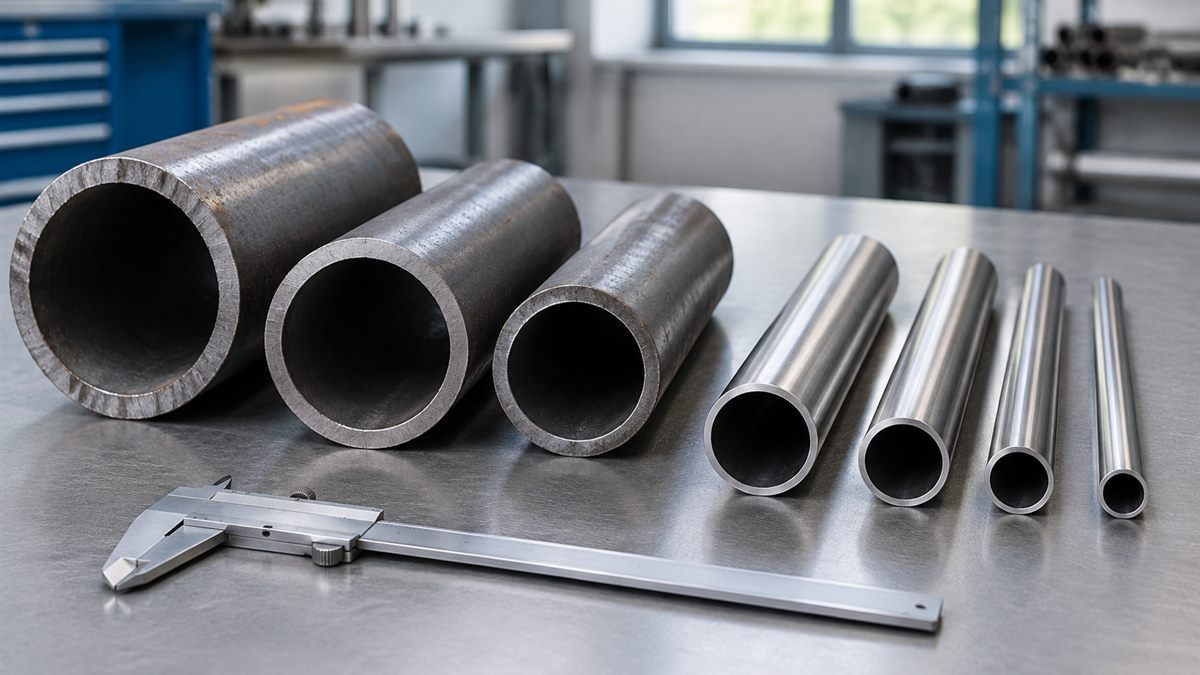
Steel pipe and steel tube are not interchangeable buying terms. Pipe is normally ordered through a nominal size system such as NPS or DN, together with a schedule or specified wall thickness. Tube is normally ordered by an actual outside dimension and wall thickness, with dimensional tolerances chosen for the intended fabrication or mechanical function.
The distinction is less about the object being round and more about how its dimensions, tolerances, and end use are communicated. A buyer who writes only “50 mm steel pipe” or “2-inch steel tube” may leave the supplier to guess which dimensional system applies. The safest RFQ states the product form, governing specification, dimension convention, wall, length, tolerance needs, and intended processing.
Why Pipe and Tube Use Different Naming Systems

Pipe terminology developed around moving a medium through a system. That purchasing language therefore tends to organize products by nominal bore families, compatible fittings, wall designations, and connection requirements. The nominal label is an identifier within a dimensional standard; it should not be treated as a direct measurement of the outside diameter.
Tube terminology is more closely tied to the physical section used in fabrication, equipment, mechanical assemblies, or heat-transfer work. Buyers commonly identify tube by an actual outside dimension and wall thickness. Shape may also be part of the definition because tube can be round, square, rectangular, or another controlled profile.
Terminology Translator
| Buying concept | Pipe language | Tube language | What to confirm |
|---|---|---|---|
| Primary size label | NPS or DN nominal designation | Actual outside dimension or section dimensions | Which dimensional standard governs |
| Wall | Schedule or stated wall thickness | Stated wall thickness | Permitted wall tolerance and measurement basis |
| Inside space | Changes when wall changes within a nominal size | Derived from outside dimension and wall for round tube | Whether internal clearance is function-critical |
| Fit emphasis | System components, fittings, ends, and service specification | Fabrication fit, forming, assembly, and surface needs | Critical mating or processing dimensions |
| Order wording | Product standard + nominal size + schedule/wall | Product standard + actual dimensions + wall | Grade, length, ends, quantity, and inspection documents |
Nominal Size Is Not the Same as Measured Diameter
NPS and DN are designation systems. They help buyers and suppliers refer to a standardized pipe family, but the label alone does not provide every physical dimension. The outside diameter associated with a nominal size must be read from the governing dimensional standard. The schedule or specified wall then determines the wall thickness for that nominal size.
This produces an important purchasing consequence: two pipes with the same nominal size can retain the same standardized outside diameter while having different walls and therefore different inside clearances. Conversely, a tube order expressed as outside dimension by wall is intended to communicate the physical section directly, subject to the tolerances in the cited specification.
Pipe expression
Nominal size + wall designation
Example format: NPS or DN, schedule or minimum/nominal wall, specification, grade, and end condition.
Tube expression
Actual outside dimension × wall
Example format: outside dimension, wall thickness, shape if not round, specification, grade, length, and tolerance class where applicable.
Do not convert between the two expressions by arithmetic alone. Availability, dimensional series, tolerances, and manufacturing provisions come from the selected specification. A drawing dimension is not a substitute for a material standard, and a nominal product name is not a substitute for a controlled drawing where fit is critical.
Where Tolerances Change the Buying Decision

Calling a product “tube” does not automatically guarantee a tighter tolerance, and calling it “pipe” does not make precision irrelevant. The controlling document is the applicable product or dimensional specification plus any agreed supplementary requirement. Buyers should identify which dimensions affect fit or processing instead of asking for “tight tolerance” without a measurable reference.
- Outside dimension: important for clamps, sleeves, rollers, holes, and automated feeding.
- Wall thickness: affects section geometry, mass, forming behavior, and available internal clearance.
- Ovality or profile: may matter when a round section enters a close-fitting assembly or when shaped tube must align with fixtures.
- Straightness and twist: can influence long fabricated members, racks, frames, and repeatable cutting.
- Length and cut condition: determine whether stock can feed downstream equipment or requires additional preparation.
- Surface and seam orientation: may matter for visible fabrication or later forming, but requirements must be stated rather than assumed.
A practical tolerance note identifies the controlled feature, the governing clause or drawing, the inspection method, and the acceptance document. This is more useful than applying a blanket tolerance demand to every dimension, which can restrict sourcing without improving the finished assembly.
Use Application Language Without Renaming the Product
End use helps a supplier understand which dimensions deserve attention, but it should not replace the specification. “For a pressure line,” “for a welded frame,” or “for machining into sleeves” provides context; it does not independently define grade, size, wall, tolerance, or inspection.
For system piping, the RFQ may emphasize nominal size, wall designation, end preparation, joining method, and compatibility with specified components. For mechanical or fabricated tube, it may emphasize actual outside dimensions, shape, wall, straightness, surface condition, and the operations that follow, such as cutting, bending, welding, or machining.
Hypothetical clarification case
A drawing calls for a round steel member to pass through a fixed collar. The initial inquiry says only “steel pipe, 60 mm.” Before quotation, the buyer should clarify whether 60 mm is a nominal label, an actual outside-diameter requirement, or a drawing reference. If collar fit is critical, the RFQ should state the required actual outside dimension and tolerance, wall, material specification, length, and inspection basis. The supplier can then determine whether the compliant product is sold as pipe or tube under the chosen standard.
Translate the Requirement into an RFQ

- Name the product form. State steel pipe or steel tube and identify round, square, rectangular, or another shape.
- Cite the governing specification and edition. This anchors manufacturing, dimensions, tolerances, testing, and marking to an agreed document.
- Use the correct size grammar. For pipe, state NPS or DN plus schedule or wall. For tube, state actual outside or section dimensions plus wall.
- Identify only the critical tolerances. Reference the standard clause or controlled drawing where fit or processing needs more than the base requirement.
- Add processing context. State intended cutting, bending, welding, threading, grooving, machining, or assembly where it affects quotation.
- Complete the commercial quantity description. Include length basis, quantity or total mass, packaging expectations, and requested inspection documents.
Pipe wording pattern
Steel pipe; governing specification and edition; grade/type; NPS or DN; schedule or stated wall; length; end preparation; surface or coating requirement; quantity; required inspection documents.
Tube wording pattern
Steel tube; governing specification and edition; grade; shape; actual outside or section dimensions × wall; length; critical tolerances; surface condition; downstream process; quantity; required inspection documents.
These are wording patterns, not universal specifications. Engineering requirements, applicable codes, and the selected standard govern the final purchase order.
Questions Buyers Ask About Pipe and Tube Terms
Is pipe size the same as its outside diameter?
Not necessarily. NPS and DN are nominal designations. Use the applicable dimensional standard to identify the corresponding outside diameter and wall for the selected designation.
Can I order tube by schedule?
Schedule is primarily pipe purchasing language. If a product is required as tube, state the actual outside or section dimensions and wall thickness under the relevant tube specification. Do not assume a schedule label creates an equivalent tube order.
Does tube always have tighter tolerances than pipe?
No. Tolerances depend on the governing specification, product form, manufacturing route, dimension range, and any agreed supplementary requirement. Compare the actual clauses relevant to the order.
What if an existing drawing uses “pipe” but gives an exact outside dimension?
Flag the inconsistency before quotation. Confirm whether the drawing dimension is controlling, whether the intended product standard offers that dimension, and which tolerances and mating features apply.
Buying Takeaway
The reliable distinction is the specification language: pipe uses a nominal size system tied to a dimensional standard and wall designation, while tube is generally described by actual outside or section dimensions and wall. Translate the functional need into that language, identify the dimensions that truly control fit, and place the governing standard and edition in the RFQ. That removes ambiguity without treating pipe and tube as universally interchangeable.