Steel Pipe End Types Explained: Plain, Beveled, Threaded and Grooved
- Share
- publisher
- Junnan Steel
- Issue Time
- Nov 25,2026
Summary
Compare plain, beveled, threaded and grooved steel pipe ends, then specify connection compatibility, inspection and transit protection.
Connection-led end selection
Steel pipe end types are not interchangeable labels. A plain, beveled, threaded or grooved end must match the planned joint, the governing standard, the pipe dimensions and the approved installation method.
Direct answer
Use plain ends where the next fabrication step or connection system requires an unprepared square end; beveled ends where an approved butt-weld joint requires a specified edge preparation; threaded or coupled ends only where the pipe, thread form and service specification permit a threaded connection; and grooved ends only with a compatible mechanical-groove system. State the end standard, dimensions, protectors and inspection evidence in the purchase order.
Match the end preparation to the connection
| End type | Connection context | Buyer must define | Receiving focus |
|---|---|---|---|
| Plain end | Cut end supplied without a bevel, external thread or mechanical groove; often prepared later for fabrication or a compatible joining system. | Squareness, burr condition, length basis and any later field or shop preparation. | Deformation, heavy burrs, dents, contamination and damage that affects the next operation. |
| Beveled end | Edge preparation for an approved butt-weld joint; the bevel alone is not a welding procedure. | Applicable standard or drawing, angle or land terminology, tolerances and whether ends are capped. | Uniform preparation, edge damage, rust, contamination and traceability to the line item. |
| Threaded or coupled | External pipe thread, sometimes supplied with a coupling, for a system that explicitly accepts that thread and service. | Thread standard, taper or form, end engagement requirements, coupling requirement and thread protection. | Torn or flattened threads, corrosion, dirt, protector condition and correct coupling identity. |
| Grooved end | Rolled or cut circumferential groove used with a compatible mechanical coupling system. | Groove system and standard, roll- or cut-groove method where relevant, dimensional range and pipe compatibility. | Groove damage, distortion, coating buildup, out-of-roundness and compatibility records. |
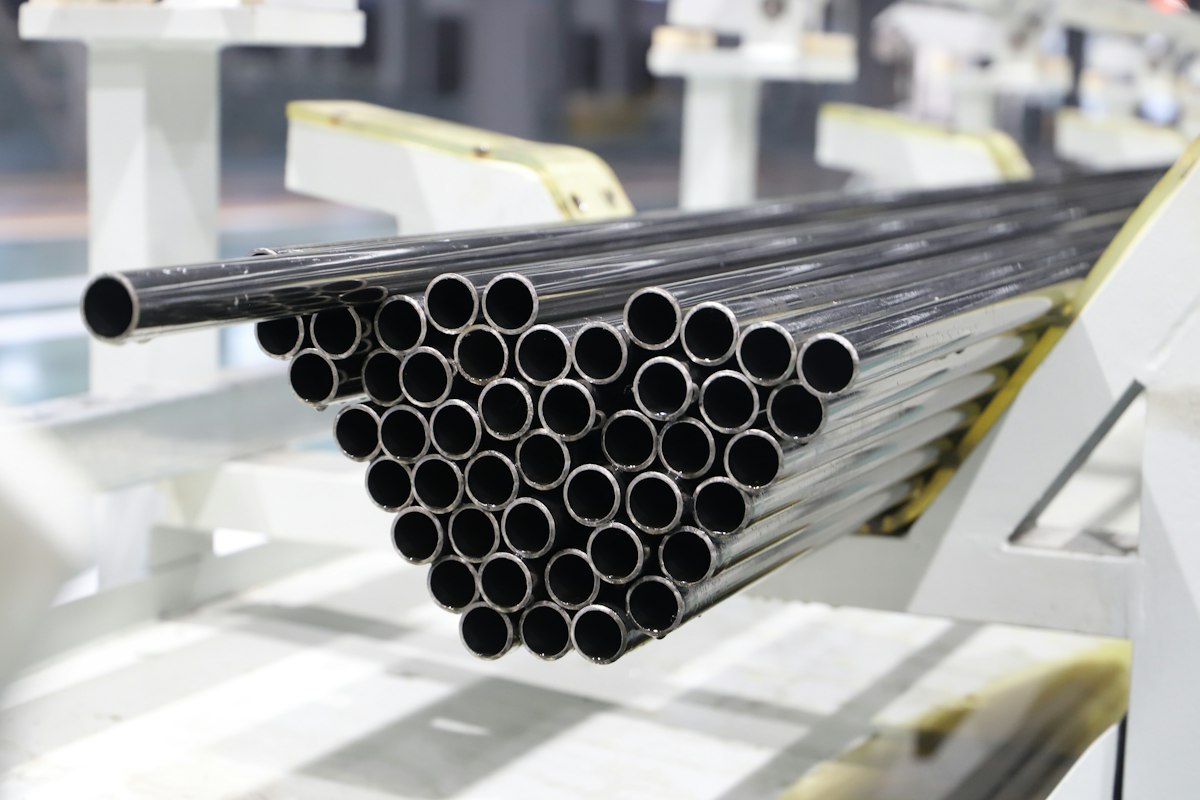
Image boundary: the photograph provides stock-handling context only. It does not identify any specific end preparation.
Plain and beveled ends serve different next steps
Plain ends
“Plain” should not be treated as “no requirements.” The order may still need limits for cut quality, burrs, end squareness, end distortion and cleanliness. A plain end can be the input for later beveling, threading, grooving or another approved fabrication operation, but procurement should not assume which operation will follow.
Beveled ends
A bevel changes edge geometry for a planned welded joint. It does not establish the welding process, filler, heat input, inspection or acceptance criteria. Those controls belong to the project design and qualified welding documentation. Purchase wording should point to the required standard, drawing or approved detail rather than use “standard bevel” without definition.
A visible chamfer is not enough evidence
Confirm the applicable end-preparation requirement and inspection method. Photographs can document general condition, but they do not replace dimensional verification or the governing acceptance criteria.
Threaded and grooved ends depend on system compatibility
Threaded or coupled ends
- Name the thread standard and form; do not rely on diameter wording alone.
- Confirm that wall, material, service and project rules permit threading.
- State whether couplings are supplied and how threads are protected.
- Keep compound, sealing and field-assembly requirements in the approved installation procedure.
Grooved ends
- Name the compatible coupling system and groove requirement.
- Distinguish a formed roll groove from a machined cut groove where the specification requires it.
- Check pipe dimensions, end condition and coating compatibility.
- Do not infer pressure or service suitability from the presence of a groove.
Key distinction: a thread is a helical connection feature; a mechanical groove is a circumferential recess or profile for a compatible coupling. A raised collar, decorative ring or flange is not evidence of a compliant groove.
Control preparation details in the order

- 1Name the end type for each line item. Avoid mixed shorthand when different ends apply to opposite sides.
- 2Cite the governing document and edition. Include the product, dimensional, thread, groove or project specification that controls the feature.
- 3Define dimensions and tolerances. Let the standard or approved drawing provide the actual values; do not invent a universal bevel, thread or groove dimension.
- 4State accessory and protection needs. Identify couplings, caps, thread protectors, bevel protectors, rust prevention and cleanliness controls.
- 5Request traceable evidence. Marking, inspection records and photographs should reconcile with the PO, packing list and material documents.
Image boundary: the photograph shows generic metalworking. It does not demonstrate a pipe-end process, qualified procedure or accepted result.
Protect prepared ends through transport and receiving

Before dispatch
- Remove loose debris and protect prepared surfaces as specified.
- Use caps or protectors compatible with the end type and coating.
- Separate ends from straps, forks and hard contact points where required.
- Record bundle identity and photograph representative protected ends.
At receiving
- Match markings, quantities and end type to the packing list.
- Inspect for dents, ovality, corrosion, damaged threads or grooves and chipped bevels.
- Quarantine mixed or damaged ends rather than repairing without authorization.
- Retain protectors until the approved fabrication or installation stage.
Image boundary: the pipe ends are outside the photograph. The scene illustrates transportation only and does not prove end protection or securement compliance.
Write an end-preparation line item that can be checked
Product: [pipe standard and edition], [grade/type], [NPS or OD × wall/schedule], [length and quantity].
End preparation: [plain / beveled / threaded and coupled / grooved], to [named standard, edition or approved drawing], including [required opposite-end arrangement].
Protection: [caps / thread protectors / bevel protectors / preservation], suitable for [transport and planned storage conditions].
Verification: dimensional and visual inspection to the governing acceptance basis, with markings, packing reconciliation and required records.
This structure deliberately leaves project values blank. The engineering specification and selected connection system must supply them.
Steel pipe end type FAQ
Is a plain end ready for welding?
Not necessarily. A plain end describes the supplied end condition, not an approved weld-joint preparation. The welding design and procedure determine the required preparation.
Does every beveled pipe use the same bevel?
No. Geometry and tolerance depend on the governing standard, drawing, wall, process and project requirements.
Can threaded and grooved ends be substituted?
No. They use different connection principles and hardware. Any change requires technical approval for the complete system and service.
Do plastic caps prove end compliance?
No. Protectors help prevent damage and contamination; they do not prove the hidden geometry, dimensions or acceptance.
What should photographs show before shipment?
Representative end condition, protectors, markings, bundle identity and any required measurement evidence, while remaining traceable to the inspection record.
Procurement conclusion
Select the connection first, then specify the matching end preparation. Name the controlling document, dimensions, accessories, protection and evidence; inspect the actual delivered condition; and never use a photograph or a generic label as a substitute for the approved standard and project requirements.